
Avoid building plans around one exact return
A calculator becomes more useful when it helps you think in ranges rather than certainty. Market-linked investing rarely delivers the same outcome every year, so one fixed return should be treated as an estimate, not a promise.
That is why a planning framework should include at least three versions of the future instead of one.
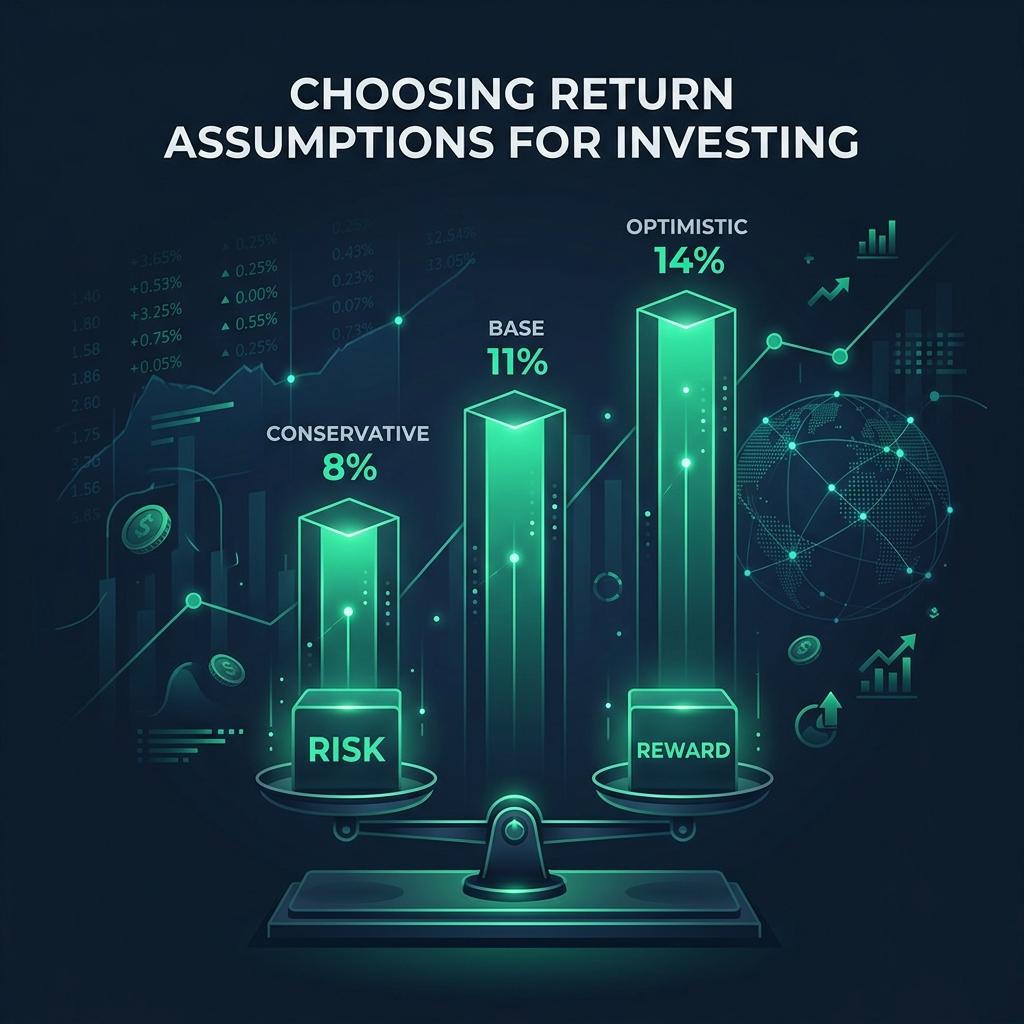
Use conservative, base, and optimistic cases
A practical scenario framework gives you a balanced way to test goals without drifting into guesswork. It also helps you see how sensitive the final outcome is to changes in return assumptions.
- Conservative: useful for understanding downside planning or stricter targets
- Base case: a realistic working assumption for regular planning reviews
- Optimistic: useful as an upper-range reference, not the only expectation
Match the return range to the goal horizon
Shorter goals usually need more caution because there is less time to recover from weak outcomes. Longer horizons can tolerate wider return ranges, but they still benefit from disciplined scenario testing.
Let the comparison guide the next action
Once the range is visible, the planning decision becomes clearer. You may need a higher SIP, a longer tenure, a different asset allocation discussion, or a more realistic target amount.
Future Corpus calculators are most useful when the return input is treated as a planning lever you review regularly, not a fixed prediction you never question.
Disclaimer: The information in this post is for educational purposes only and does not constitute financial, tax, or legal advice. Always consult a SEBI-registered advisor before making investment decisions.